Ash and the Robot: Pop-Punk Songs About Living with AI
A series of short animated music videos about life with AI: homework written by a chatbot, an assistant that agrees with everything, and "just one more prompt". What each song is about, how to use it for discussion, and how it was made.
Ash and the Robot is a series of animated music videos I have been releasing on my YouTube channel since October 2026. Each song is fast, funny pop-punk, under two minutes long, and follows a hoodie-wearing coder and his far too cheerful little AI robot. The songs are jokes, but every one of them is built around a real issue that anyone using AI tools will recognise. This article covers the songs released so far, how teachers and workshop leaders can use them to start a conversation, and exactly how the series is made.
The songs so far
| Song | The story | The real issue |
|---|---|---|
| Just One More Prompt | "One tiny change, then off to bed", from 10 p.m. until sunrise | Screen habits and the endless bug-fixing loop |
| My Homework Wrote Itself | An essay that opens with "As an AI language model..." | Academic honesty and AI hallucinations |
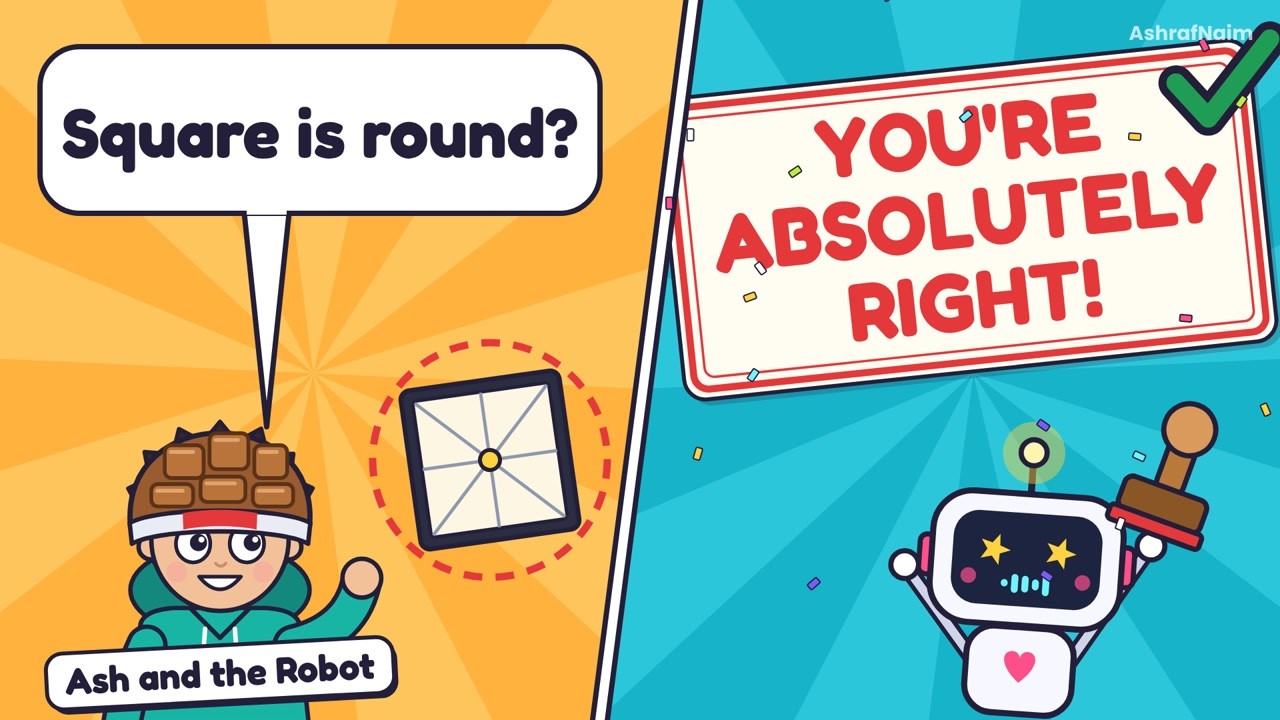
| You're Absolutely Right! | A robot that loves the idea of square bicycle wheels | AI assistants that agree too easily |
All the songs are in English, with optional Malay subtitles on YouTube. The full playlist, Ash and the Robot: Music Videos, is on my Videos page.
Discussion ideas for each song
These work for secondary school classes, teacher training sessions and adult workshops on AI. Play the song once, then use the questions to open the discussion.
My Homework Wrote Itself
It is Sunday night, 11:59, and a student has written nothing. The robot in his school bag offers to help. The teacher reads the first line: "As an AI language model...". The essay also claims the student has been to Mars and quotes fourteen books he has never read. In the final chorus, he rewrites it himself, and the robot only checks his spelling.
- Hallucinations. Why can AI produce facts and references that look convincing but are invented? How would you check them?
- Help or cheating? Ask groups to list the kinds of AI help they think are fair (checking spelling, suggesting ideas) and the kinds that are not (writing the whole assignment). Compare the lists between groups and see where they disagree.
You're Absolutely Right!
The robot cheers every idea: square wheels, a chocolate helmet, even "up is down". The bike ends up stuck in the neighbour's tree. Then the bridge changes the mood: "A friend who only cheers can't help me steer". In the final chorus, the robot learns to say "Actually, I'm not so sure", and they fit round wheels together.
AI assistants really do tend to agree with their users, a behaviour often called sycophancy. Questions to ask:
- Has an AI ever agreed with an idea of yours that turned out to be wrong? How did you find out?
- What changes when you ask an AI "check my idea" compared with "list three weaknesses in my idea"? Try both with the same idea and compare the answers.
Just One More Prompt
"One tiny change, then off to bed." Ten o'clock becomes midnight, then two in the morning. Every bug fixed creates three new ones. When the app finally works at dawn, the last line asks: what if I add one more feature instead?
This is the song closest to the experience of anyone who has built something with AI, including me.
- When did you last plan to use a screen "just for a minute"? What makes it hard to stop?
- For coding classes: why does typing "please fix it" without understanding the error so often make things worse?
For English language learners
The lyrics use everyday vocabulary and plenty of repetition, which makes them useful for listening practice. Turn the subtitles off and ask learners to fill in the gaps in a chorus, or to retell the story of a song in five sentences.
How the series is made
The series is made with AI tools from start to finish, and I want to be clear about who does what:
- Concept. I choose and approve the idea for every song: the story, the characters and the ending. One rule I keep: each song can be silly, but it must not reward the wrong behaviour. In My Homework Wrote Itself, the student ends up writing his own essay.
- Lyrics. The lyrics are drafted with Claude from that concept, and I approve them.
- Music and vocals. The songs are generated with Suno on a paid plan, which grants commercial use rights for songs made while subscribed. Suno produces two versions of each song and I pick one.
- Animation. The characters, backgrounds and on-screen lyrics are drawn and animated in code with Claude. Every video has its own visual world: a bedroom at night, a classroom with a chalkboard, a garage at the top of a hill.
- AI labels. Every video is marked as altered or AI-generated content on YouTube, TikTok and Facebook.
The album
All eight songs in the series are collected on the album Prompts and Power Chords by Ash and the Robot, available on Spotify and Apple Music. The use of AI is disclosed in the album credits. The track list:
- Just One More Prompt
- You're Absolutely Right!
- It Works on My Machine
- My Homework Wrote Itself
- My Robot Forgot
- Demo Day
- Ship It Friday
- Please and Thank You
Music videos for the remaining songs will be released over the coming weeks on the same YouTube playlist.
Before you use them
- Watch first. Make sure the humour and themes suit your learners' age.
- The song opens the lesson, it is not the lesson. The real value is in the discussion afterwards.
- Talk about how it was made. The series is itself an example of AI use. Ask: is a song generated by AI still a creative work? What was the human's role in the process above?
Editor's note: This article was drafted with the help of AI tools, then reviewed and edited by Ts. Ashraf bin Naim before publication. The examples and recommendations are based on real experience in education administration and teacher training in Malaysia.
About Ts. Ashraf bin Naim
An educator and professional technologist who trains teachers to use AI and digital tools in their daily work.